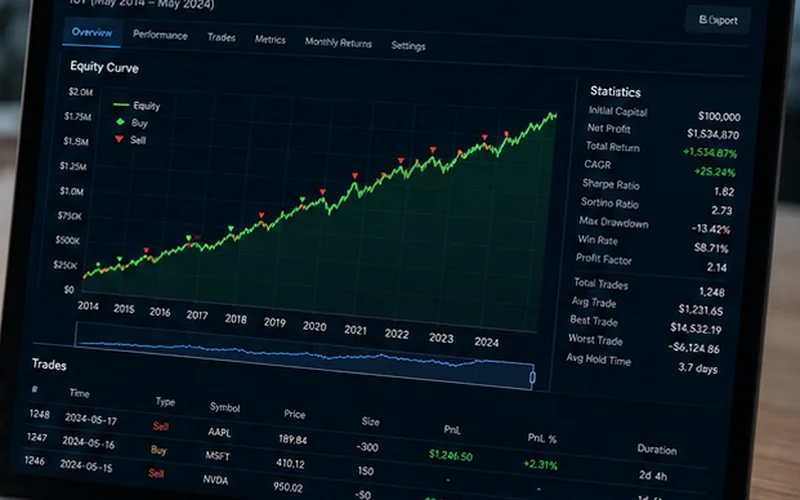
Are you interested in investing but not sure where to start? Let’s introduce you to quantitative investing. This method relies on numbers, data, and analysis to help with decision-making. Instead of acting on headlines, hunches, or the mood of the market, a quantitative investor follows clear rules that can be written down, tested, and repeated. In this guide we explain what the approach involves, which building blocks matter most, and how a complete beginner can take the first careful steps.
What Is Quantitative Investing?
Quantitative investing is the practice of making investment decisions with mathematical models rather than personal judgment. A strategy defines exact conditions for buying and selling — for example, purchasing an asset when its price rises above a long-term average and selling when momentum fades. Because every rule is explicit, the whole strategy can be tested against years of historical data before a single dollar is put at risk.
The approach does not guarantee profits. What it does is remove emotion from execution and replace it with discipline, which is often the hardest part of investing to master.

The Building Blocks of a Quant Strategy
Most quantitative systems, from weekend projects to professional funds, are assembled from the same four components.
| Component | What It Does | Beginner Example |
| Data | Supplies the numbers the model works with | Daily closing prices and trading volume |
| Signal | Defines exactly when to buy or sell | A 50-day average crossing the 200-day average |
| Risk rules | Limit how much any single trade can lose | Risking no more than 2% of capital per position |
| Backtest | Checks the rules against past markets | Running the strategy across ten years of history |
How to Get Started
- Learn basic statistics before committing real money.
- Pick one simple, well-documented strategy and study it thoroughly.
- Backtest the rules on at least several years of historical data.
- Run the strategy in a demo account until you trust its behavior.
- Start small, keep records, and change rules only when the evidence demands it.
In quantitative investing the model does the deciding — your job is to make sure the model deserves that trust.
Patience matters more than brilliance here. A modest, well-tested system followed consistently will usually outperform a clever idea abandoned after its first losing week.